

Last week, I was invited to speak at a networking event for startup founders and enthusiasts where I was asked by a member of the audience if I had any ideas for a new startup or a business. Through our conversation, we came to the conclusion that ideas are actually not the genesis of products or organizations; pain points are.
An eventually-successful product, more often than not, starts with a gap in society that people recognize. That gap needs to be a pain point felt by someone who decides to do something about it to make their life easier. Let’s take the example of online banking. As access to the internet became widespread, people felt the pain of commuting to their local bank branch just to transfer money to another bank account. Making the commute could often be long and tiring, and prevented customers from spending their time in more meaningful ways, such as spending it with their family, working on a hobby, completing chores, and so on. Often when customers got to the bank, they would have to wait for a teller or bank representative to get free to help them make the transfer. Acknowledging this, banks then came up with different ways to address that customer pain point, through services such as online banking and telephonic transfers for customers who may not have reliable access to the internet. Banks realized that a majority of customers wanted the option of carrying out online banking services from the comfort of their homes or wherever else they happen to be. The spread of cheap and reliable internet across many parts of the world made the pain point easy to address. A sample vision that banks and customers had after noticing the pain point, could be something like “A world where every XYZ Bank customer can use the bank’s services from any part of the world.”
A vision is more important for the creation of an organization or a product than an idea. While an idea is usually related to one of many possible solutions, a vision more holistically addresses a problem that a certain niche of people face. Great products start with customer problems. As a founder, you know that your product has the potential to have an impact on the world if it addresses a certain pain point that people feel. There are often many ways and ideas to address that specific problem. A product’s competitive advantage actually stems from how it decides to address that customer problem, and if that’s done in a margin-enhancing way.

The benefit of having a vision statement is that it helps people building the product or organization decide everything else that’s “downstream” of it. In the image above, a company would create its mission based on the vision, its strategy based on the mission, and so on. Without these foundational elements of a product in place, companies will struggle to have an impact and build successful products. Each icon on the left provides the “why” and guardrails for the icon to its right. Teams should generate backlog items to achieve its goals. Those goals should exist to help implement the product and company strategy. The strategy should exist to help a company achieve its mission. Lastly, the mission should serve the long-term vision and be a step towards achieving it.
A product vision leverages the “why” of a product. Simon Sinek eloquently summarizes the importance of a vision:
A vision statement typically addresses questions such as:
- How do you hope to impact the world and improve the lives of others?
- What is the ideal state you hope to achieve?
- Why do you want your product or service to exist?
The vision statement of a product typically lasts for decades and changes very little, if at all. It inspires people to dream about and work towards a future where the noticed pain point is no more. The best vision statements allow people to connect their “why” to it and make it their mission to help achieve that ideal state. It allows everyone associated with the product/organization to work toward a shared purpose. Good vision statements often tend to be broad and a bit vague, without identifying how the product or organization plans to address certain problems.
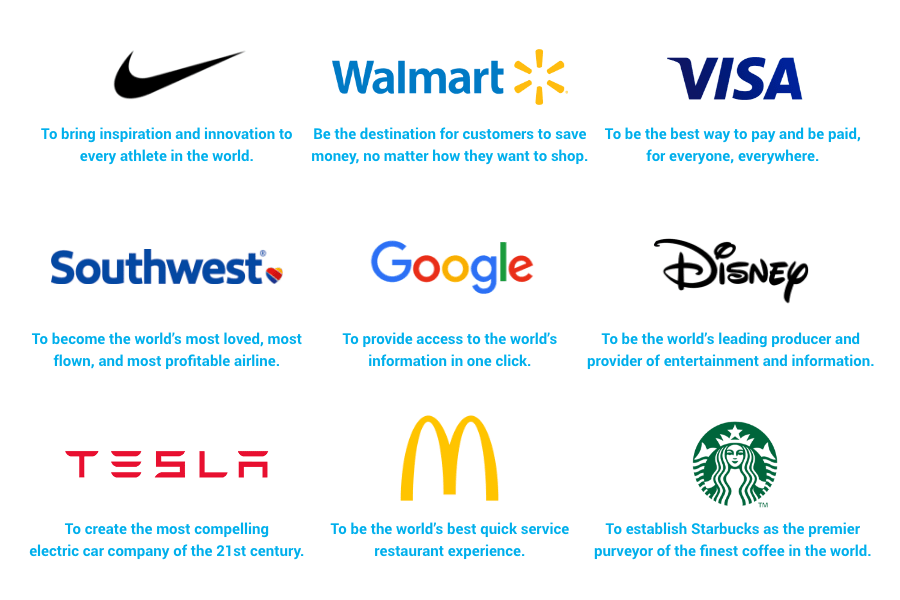
The above includes vision statements from some companies you may have heard of. Note how Nike’s vision statement has nothing to do with clothing or sports equipment. The reason they manufacture sports clothing and equipment is to bring “inspiration and innovation to every athlete in the world”. On their website, Nike defines “athlete” as anyone with a body. Similarly, Google’s old statement doesn’t explicitly say they want to create a search engine, web browser, or provide cloud services. Rather, products such as Chrome, GMail, Google Cloud, and Google.com help their customers access information from around the world quickly and conveniently “in one click”.
The image above also details some sub-par vision statements. Based off of just the vision statements, would you be more inspired to work for Nike, Telsa, or Starbucks? While Nike’s statement is focused on the value they want to bring to society as a whole, Starbucks and Tesla seem more concerned about making their company the “most compelling” and “premier purveyor” rather than solving a problem in society, as the Simon Sinek video alluded to. Going off just the vision statements, most people would have more interest in “bringing innovation and inspiration to athletes” rather than making Tesla or Starbucks the most successful company in the market. The former seems a far more worthwhile cause because it isn’t inward-looking and selfish, and has the potential to impact more lives for the better.
Vision statements can be created at different levels of an organization. While not every level of an org has to have a vision, they need to “attach themselves to” the vision of the level above, as Simon Sinek suggests. Typically when creating a departmental vision statement, the department leads highlight and describe the company vision in more detail for the team leads in a session. They also add more context to the statement and how they see the department contributing to part(s) of the company vision statement. The team leads then use that context to formulate a statement that is representative of how the department is expected to contribute to the company vision. When formulating a department vision, it’s not uncommon to see team leads look at the activities they are currently doing (projects, backlog items, etc) in order to generate a vision statement. This is a common antipattern to avoid as the vision and mission statements should help you decide which strategy and goals to set, which in turn should dictate the activities that teams work on. If a certain project isn’t helping achieve certain goals that are aligned with the strategy or vision then they should not be worked on.
In larger (1000+ headcount) organizations, it may be redundant to create vision statements at a team level. In situations where it doesn’t make sense to create team vision statements, teams can formulate a mission statement that serves the departmental vision. The next blog post will detail what a mission statement is, why it’s needed, and how it differs from a vision statement.

 Rahul Bhattacharya
5 thoughts on “Product vision”