
In simplest terms, the market is everything outside an organization. Think of a farmers’ market that consists of sellers and buyers who come to exchange money, time, goods, and services. In a farmers’ market that specifically caters to vegan customers, it probably doesn’t make much sense for a butcher to set up a booth and sell different cuts of meat. Similarly, understanding the characteristics of the market that the organization operates in, allows it to internally define a vision, mission, and strategy that has a high chance of success.
It’s not enough to know what the organization is trying to accomplish. Being aware of the internal and external context that the organization finds itself in allows work across the different flight levels (Level 1: team and operations, Level 2: coordination, and Level 3: strategy and portfolio) to have more context and better alignment.
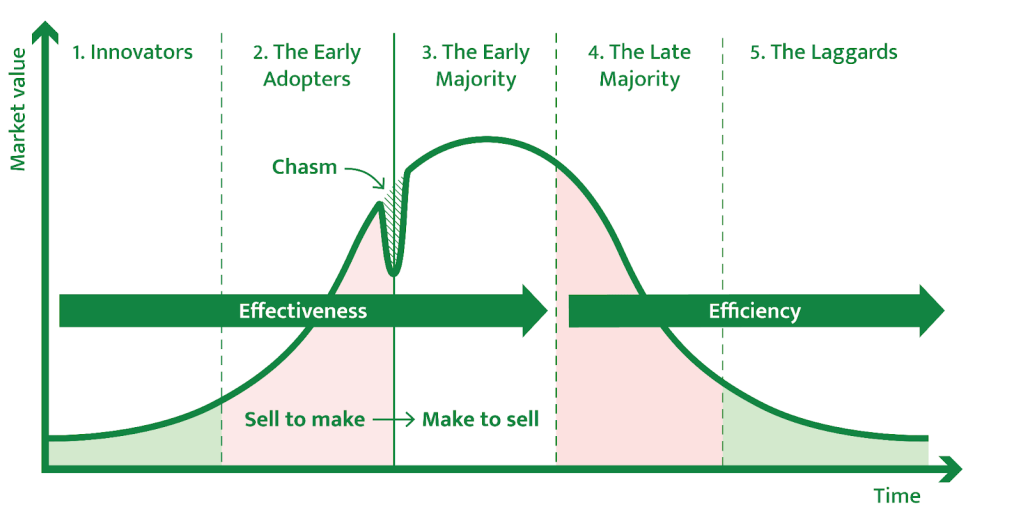
The market adoption curve can be helpful in understanding the domain that the organization finds itself in. This version of the market adoption curve is one that Geoffrey Moore, in his book, Crossing the Chasm modified, based on Everett M. Rogers and his classic book Diffusion of Innovations.
The innovators are the smallest group in the curve. They represent people who are curious bout new technology and probably don’t even have a use case for it yet. They are beta testers who enjoy learning about a new product first-hand and experimenting with it before others know about it. When addressing this niche, a pre-launch exclusive message that offers your product(s) for free to these individuals can help you gain initial traction and feedback. Recent products like Clubhouse leveraged this method well by allowing invite-only signups.
The early adopters are slightly more risk-averse than the innovators. They want to be one of the first ones to use a product but want others to try it first before they read the reviews and commit their time and money. This niche of individuals want new products and they are happy to pay the necessary amount for them if the initial reviews seem promising. On the other hand, they expect immediate value from the product, that is customized to their needs and context. When selling to this crowd, clearly highlight the pain points that your products can help solve and the situations where they can be the most useful. Tailoring your products to the individuals during this phase can greatly help in acquiring potential evangelists.
The early majority, which represents about a third of the market, is the hardest segment of customers to reach, because of the chasm that exists in between. Geoff Moore argues that the chasm exists due to the wildly different expectations that the two neighboring segments have from a product. Product positioning plays a key role in crossing the chasm. In Geoff’s words, “The value proposition has to switch from ‘look at all the great things that can happen’ to ‘look at all the tough problems you can solve if you’re willing to step up to the new technology.’” Using testimonials, case studies, and success stories from well-known early adopters can greatly help as they are the sort of individuals that the majority follow and know of. The intent of the early majority is to solve their problems in a practical way. These individuals are open to new products but have a generally low tolerance for technical issues.
The late majority adopt a product because of their need and the product’s proven value. As big in size as the early majority, the late majority tends to lead to a high number of sales. The individuals in this group may have seen their peers or competitors use the product or something similar, and don’t want to be left behind. As with the early majority, show the late majority how the product can solve their problem and leverage FOMO (fear of missing out) by showing what their peers and competitors are using. Additionally, showing them how you can help them easily transition from another product that they may be using, to your product can quicken sales and growth.
Lastly, the laggards are the most skeptical bunch. They may decide to switch to your product once all the buzz and commotion has died down. Laggards are resistant to change and are extremely risk-averse. Running marketing and sales campaigns specific to their needs and uses cases can help convince them of the value of your product. Furthermore, ways of reducing their potential risk, such as refunds and money-back guarantees can help sway this crowd.
When drawing out your market adoption curve, come up with target metrics and indicators that will help inform your organization where they are. For example, you may use the percentage of market size that your customer base represents, or typical customer engagement characteristics, as indicators of where the company finds itself. My colleague Paweł Huryn has a comprehensive list of metrics that you can select from.
On the left side of the curve, customers want a product or service quickly. The product may not include all the bells and whistles but should have the core functionalities that allow the customers to address their problem(s) with it. The chasm refers to the gap that products face when jumping from targeting the early adopters to the early majority of customers. This is the inflection point at which the product faces a test to see whether it has achieved product-market fit (PMF) or not. Seeing your product being accepted by the early majority is a sign that it has achieved product-market fit. Favorable pirate metrics, especially acquisition, activation, and referral, can indicate that your product is on track to achieve PMF. At this stage, you would move forward with the business model that you have and build on it by expanding the offerings and fleshing out different parts of the product to higher fidelity. On the right side of the curve, customers don’t want new products. The product or service has already achieved a product-market fit and customers are looking for higher quality in the offered product, for ease of use.
As a general trend over the past 30 years, the market cycle has been shrinking, meaning that the average number of years that a product spends in all the phases of the diagram above is decreasing. Lots of large corporations are now in trouble because they are fat-tailed. They focus more on making the product or service more efficient rather than innovating new offers to better meet the evolving market needs. To make up for their lack of appeal to the early and late majority of customers, large organizations sometimes acquire startups to add a startup-like culture to their existing culture and ways of working. This approach often fails because it’s the startups that tend to become integrated into the more dysfunctional larger corporate culture. Another approach large corporations take is to acquire startups or smaller organizations and isolate them in the wider organization as a “center of excellence” or “innovation center”. This is also sub-optimal as the smaller organization tends to then sequester the knowledge within itself rather than spreading it around the larger organization. As a result, the smaller and larger organizations can become bottlenecks for each other.
In the next post, we will build on the market adoption curve and take a closer look at how to learn more about your customers.


5 thoughts on “The Market”