

Once you’ve completed the first step in introducing a PLG motion for a downmarket product category, identify the success moments for the primary ICPs. This step is key to better understanding and refining your ICPs and cohorts based on their product usage behaviors. PLG motions aren’t just about acquiring more customers; they’re also about defending them (with your product’s hard-to-copy value proposition, aka “moat“) by constantly providing them with more value.
Success moments for individuals
Customer success moments are moments in the user journey that indicate they derive value from your product. These three moments should be measurable and tailored to the specific product and its respective strategy. Use the following steps to keep track of leveraging success moments:
- Ideate and define success moments.
- Validate success moments.
- Improve activation metrics.
For step one, let’s stick to the following three moments:

A simple, precise, and measurable template to use for measuring customer success moments is:
User has used feature x, y times in the past z days.
The image below is a simple and measurable example of success moments for a ride-sharing app.

To validate your success moments, review the diagram below. A heuristic for the ideal activation rate between the Setup and Aha moments is 30-60%. An activation rate higher than 60% means you can’t optimize much. Perhaps you’re not adding enough friction to get user data/cross-sell/upsell. An activation rate lower than 30% means you may have the wrong users in the setup moment. You may need to revisit your ICPs to further segment and target through a tool like Maja Voje’s Segment Ranking Sheet. Lenny has a great list of activation metrics for different product categories.

Once you define these moments and start measuring & validating them, allow teams to own the activation metrics (highlighted in yellow in the image above). Ensure that the teams also work with other teams to optimize the individual moments as well as the entire value chain of the three steps (with something like shared goals between teams).
Success moments for teams
The same success moments (Setup, Aha, Eureka/Habit) can be used as a starting point when dealing with B2B products. The big difference with B2B products of course is that the focus is on account and team behavior rather than individuals. Team use cases tend to be faster than individual ones. Additionally, not everyone in a team needs to be engaged with a product for the team to be active.
Think of a widely used SaaS product such as Miro. A cross-functional team could include quality assurance (QA) engineers, designers, developers, and analysts. Even though only the designers, QAs, and developers use Miro on the team, the team is activated because those roles wear both creator and consumer ICP hats at different moments of their usage. Below is one example of a use case.
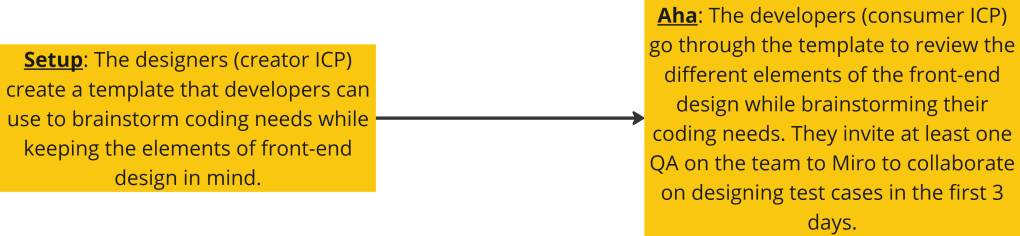
While the QAs wear a consumer ICP hat during the Aha moment, they could subsequently also wear a creator hat to create test cases for the developers. While the activation metrics in the previous section looked at individual use cases and behaviors, we are now reviewing team activation metrics. The frequency of use cases would change from looking at individuals to teams. Even though certain individuals within a team might not use a tool more than once a month, the team might have daily/weekly users.
It can also be useful to treat ICPs as teams rather than individuals by generalizing the overall usage frequency, usage volume, and use cases predominantly seen in a team. For example, for B2B products, your ICP could be a product team focused on the checkout part of the user journey. Then create success moments focused on these teams rather than specific individuals and their use cases.
Mid-market and enterprise products focus on B2B sales consisting of accounts (a collection of teams). A group of users belonging to the same account that fits into your ICPs and has a strong product signal (willingness to monetize) is referred to as product-qualified accounts (PQAs). Potential PQAs are typically scored (via something like Lead Scoring) to evaluate their willingness to pay for your product, by looking at factors such as usage volume, breadth of feature usage, and usage velocity. These scores are then used by product, marketing, and sales to focus on the accounts with the highest relevance and potential. PQAs are accounts that cross a certain scoring threshold (ie 100 points). The ones under the threshold are not PQAs and not worth focusing your time/attention on. The qualitative feedback from sales reps and quantitative analysis of the user base should then be used to fine-tune the scores and offer predictability to your growth motion.
Product-qualified leads (PQLs) are individual decision-makers within PQAs that have buying power in an organization. They often decide whether their organization should buy your product or not. Conversing with them frequently requires a different process to downmarket individuals. Marketing and Sales teams usually find these individuals to pitch to. Elena Verna has a good summary of working with PQLs and PQAs for lead scoring and beyond.
Whether you’re working with B2C or B2B SaaS products, kick off a PLG motion by learning about the ICPs, validating them through success moments, and giving teams the responsibility to improve the customer journey by measuring and tweaking activation metrics. Don’t forget to take advantage of network effects and build growth loops/flywheels into your product where possible.
As your product moves upmarket from individual users to SMBs and enterprise accounts, it becomes more important to have a product-led sales (PLS) approach where product insights feed into data to help Sales and Marketing more quickly and effectively identify and convert PQAs. The next post will look at a PLS motion as an evolution of the initial PLG plan.

 Rahul Bhattacharya
3 thoughts on “PLG success moments”