
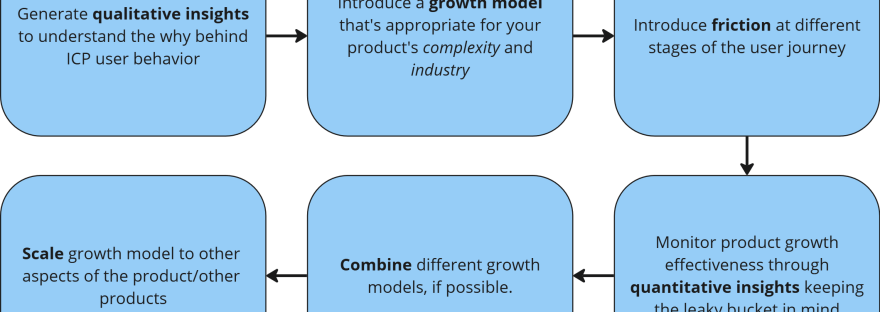
Once you’ve proven product-market fit (PMF), identified the potential of PLG/PLS/SLG growth motions, and established a foundation for scaling your product, it’s a great time to experiment with the different growth models and tactics such as freemium, reverse trials, interactive demos, and when to use gated vs ungated approaches.
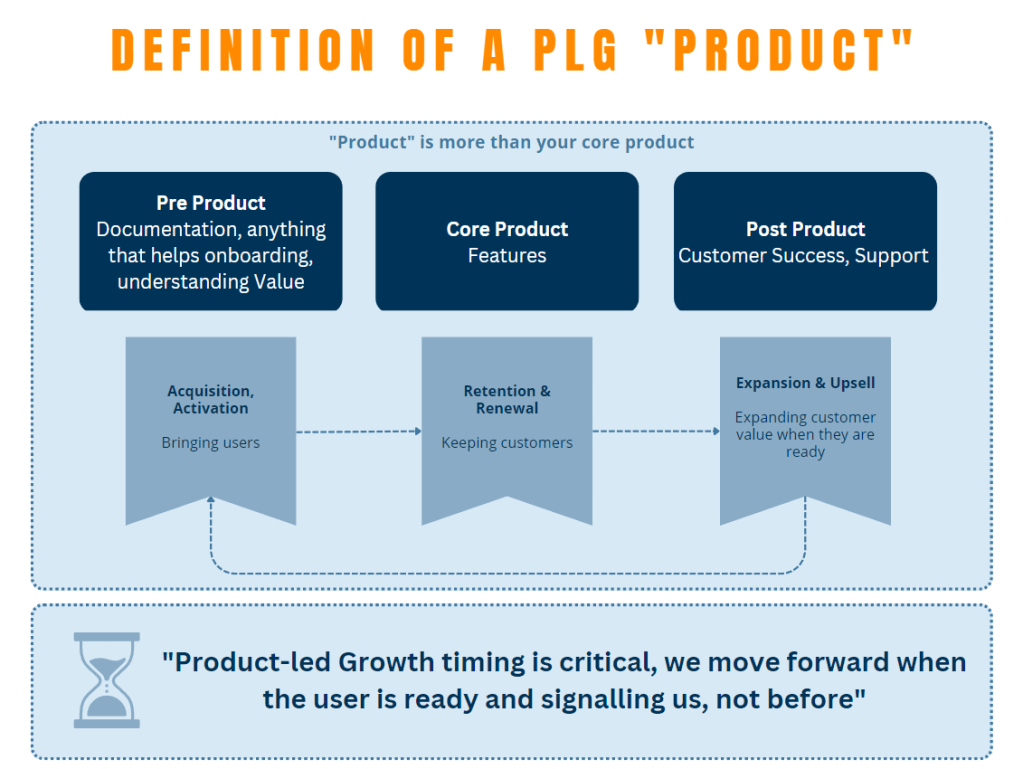
When it comes to freemium, interactive demos, and reverse trials, the question isn’t just which one to use but also when to use the appropriate one. Generally, you want to use the tactic that gets your ICPs to the Aha moment quickest and with the least friction. Especially for freemium and trial models, you want to ensure that prospects know your product’s differentiators and the core product value, before asking them for anything (like a heavy onboarding process). Eventually, the value you get from the customer should surpass the cost of experimenting with the given tactic. The quicker this happens, the better (see payback period). Leah’s definition of a product experience in the image below reminds us that the overall customer experience, besides the obvious core product value, also includes the pre- and post-product steps such as onboarding and customer support.
The different models
A freemium (a combination of free and premium) model gives users full access to and use certain parts of the product for free while only granting access to other functionalities after the user has paid. There is no time limit – the user can continue using the free features as long as they wish. A freemium model should be used when:
- The incremental cost of adding new users is low
- The core product value can be enhanced significantly with services – to get users to monetize to use the premium features.
- Usage is a great indicator of product success
Products like Spotify, LinkedIn, Dropbox, Slack, Evernote, and Mailchimp, amongst many others, have leveraged the freemium model successfully to acquire, convert, and monetize users. Free users make for excellent product analytics. Understanding what makes any user convert is a great indicator of what Marketing should double down on. A free user needs to experience some product value, but there should be clear benefits for upgrading to a paid plan. The added benefit of having free users is that they often help spread the brand through word of mouth, which is crucial for product-led motions.
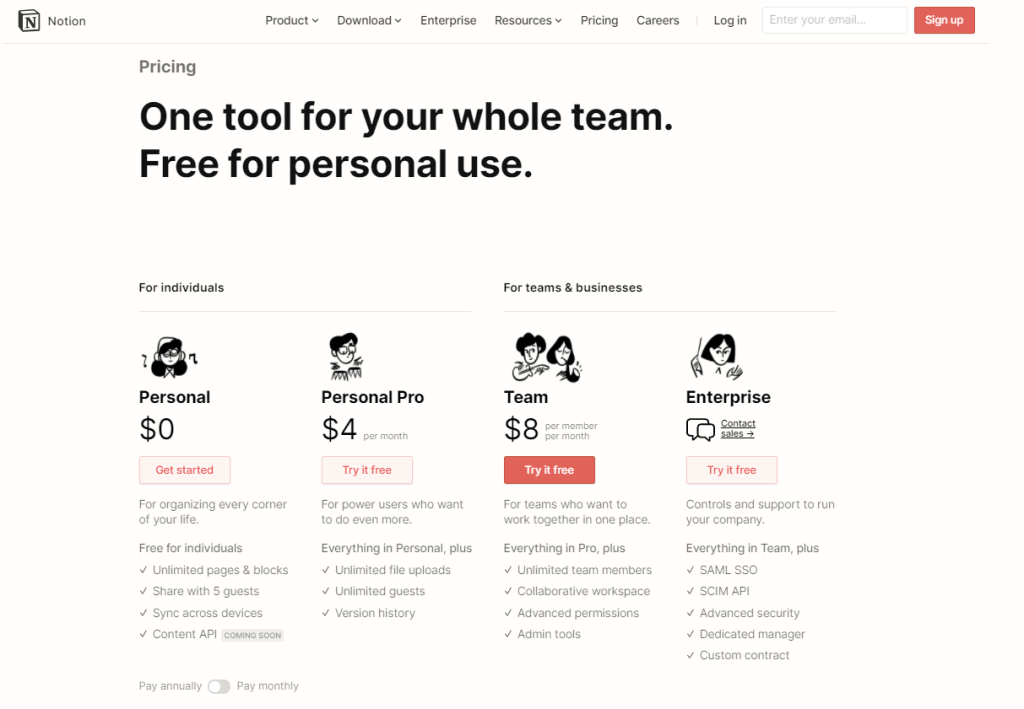
Notion’s plan above offers customers to experience the core product value of unlimited pages but limits the sharing to 5 guests. While the benefit of having unlimited pages in the free plan is obvious, the benefit of “advanced permissions” in the Team plan is not as clear. Users may hesitate to monetize if unsure whether it could benefit their use case. To make up for it, Notion can introduce in-product nudges, prompts, and highlights of such “advanced permissions” that a free user is missing out on.
If your product’s users go into freemium but don’t convert, keep these people for word-of-mouth marketing (they love your product but don’t want to pay you for different reasons). After understanding the reasons through qualitative insights, you can experiment with different versions of premium plans (e.g., limits on the number of users, number of functionalities, data volume, reporting, automation, or support). Having analytics in place is key to leveraging the freemium model. You want to focus particularly on the conversion rate to understand the stages at which certain ICPs are converting while others aren’t. Eventually, you should have enough data to evaluate Tactic A (send an email sequence) vs. Tactic B (ask Customer Success to offer one-on-one help to free users) to see which measure converts and retains your ICPs quicker.
A trial gives users access to the full core product value for a limited amount of time, after which they either upgrade or lose access to the product. It uses a try-first, decide, and pay-later approach. A trial can be useful when:
- Your product is complex – the user needs to experience everything to “get” value
- A niche market is fully aware of your product category
- The product value realization is hard to make “partially free” (as with freemium)
Trials can be nice to try before going into freemium. Doing so tests the buying intent of your current customers.
A reverse trial, on the other hand, gets the user onboarded to a timed trial after which, they can revert to a freemium option or pay to continue using the full product. Having the free option continues to offer users some potential value without them paying for it. Reverse trials are great for differentiators you want customers to see.

Calendly offers a free 14-day trial where teams can access all the possible functionalities on the website – including the premium features. If teams don’t upgrade before the trial ends, their accounts are automatically downgraded. Calendly bets that by exposing certain ICPs to their full product value upfront, teams would want to pay for the features instead of having access to a limited-functionality product once the trial ends. It becomes difficult to accept a limited-functionality product after teams have experienced the premium features. Calendly combines the freemium option for individuals (option 1 in the screenshot above) and a reverse trial option for teams (option 3 in the screenshot above). We will look at combining the different models later in this article.
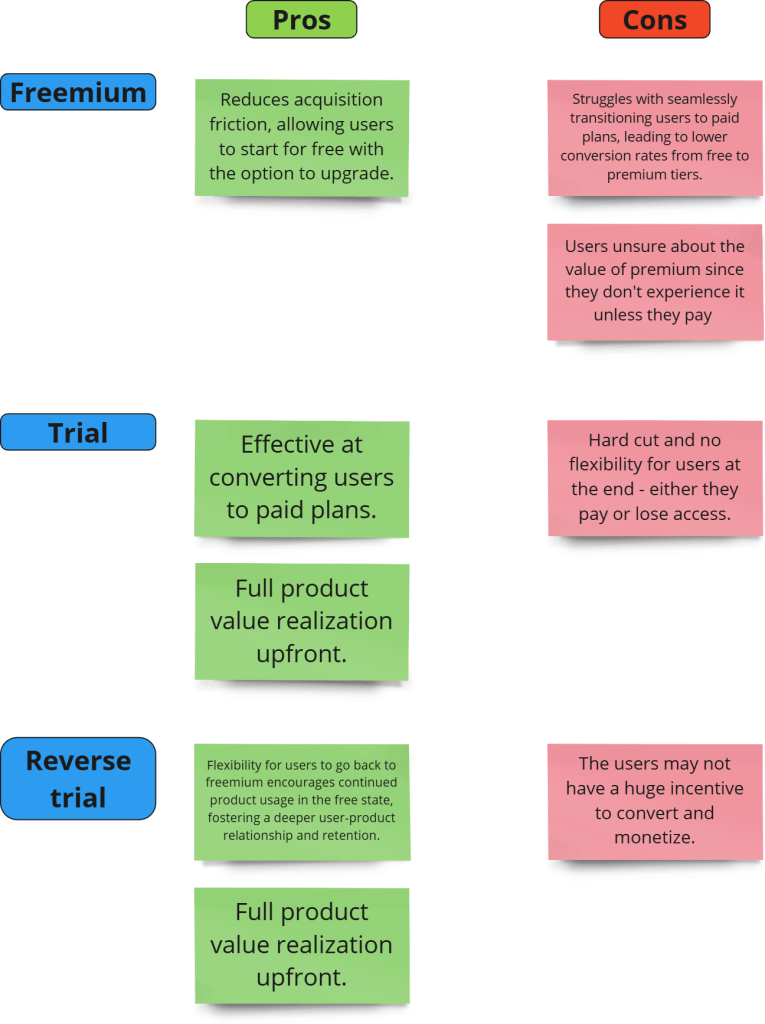
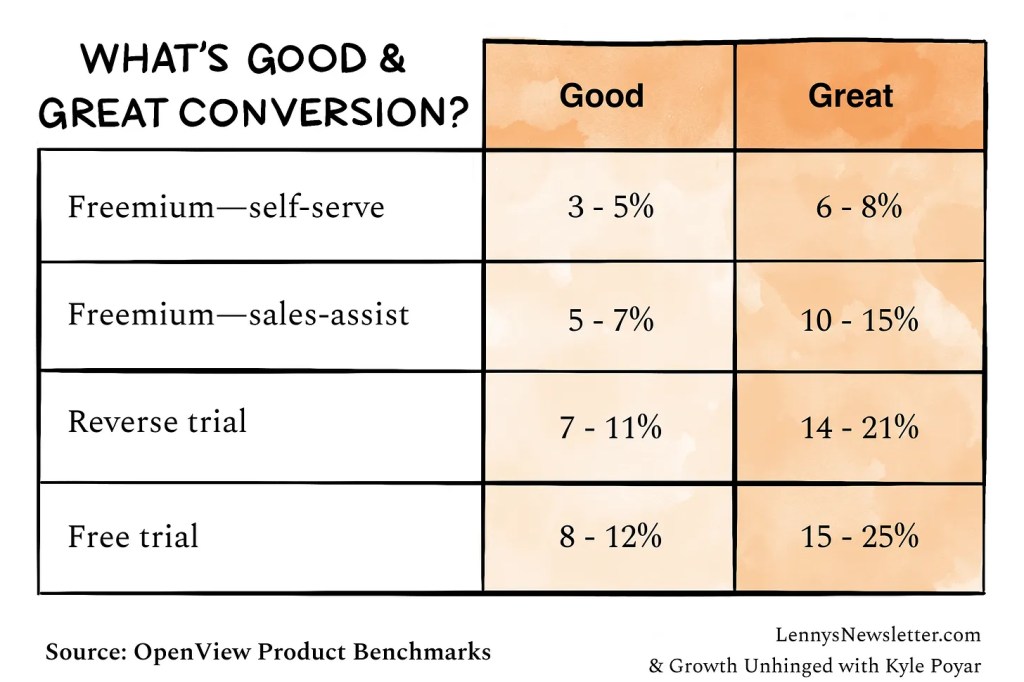
The pros and cons of each of the three models can be summarized in the image above. Additionally, I find the table below helpful when thinking about good and great conversion rates for SaaS products using each of the three models. Remember to fix a potentially leaky bucket first, and gather qualitative insights to understand the why, before focusing on a quantitative measure like conversion.
An interactive demo is a self-guided walk-through that puts a simulated version of the product in front of the user from the very beginning. This allows the users to go through the product’s main use cases that ICPs are likely to have. Interactive demos are often split by audience types (ICPs) and mimic the experience of a complex and/or heavily regulated product so that users can quickly understand whether the product could be useful for them. They can be especially useful for organizations when there is no way to “remove” sales. If you have never experimented with freemium, start with interactive demos, then trials, and finally freemiums. Take your learnings from demos to trials and freemiums to highlight differentiators.
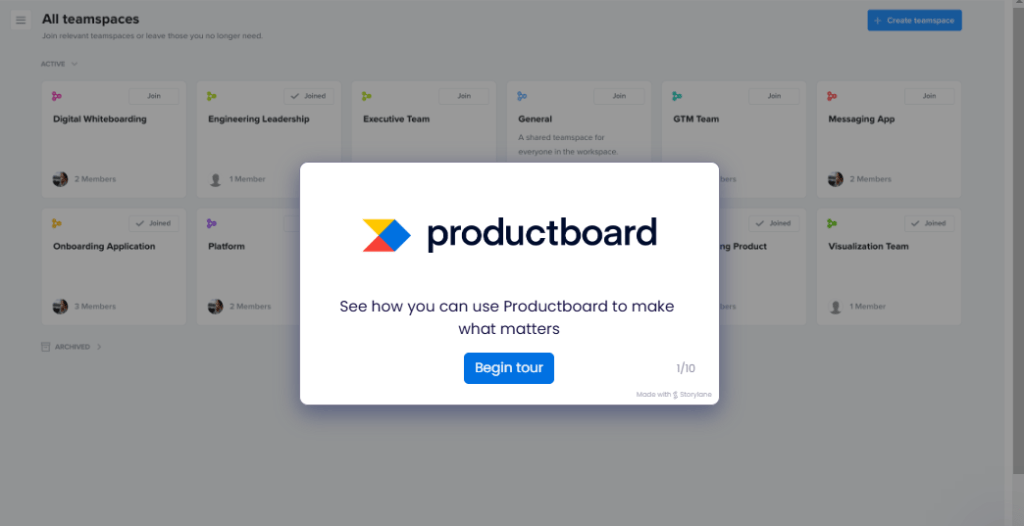
ProductBoard‘s interactive demo is 10 steps and contains a click-through tour of the key functionalities that convey the core value proposition without overburdening the user with too many features and use cases. The horizontal progress bar clarifies the remaining steps; such transparency tends to improve completion rates. In-demo prompts can include opportunities to collect firmographic data and emails that can be later used to split test users who completed the demo and others who didn’t. The findings can be useful to score the leads and give them flags in the system, such as “seen demo” or “canceled on step 3”.
Interactive demos allow potential customers to have a clear expectation of how they can benefit from using your product. Such clarity can be crucial for complex products, especially in regulated environments, where it may be difficult to allow users to experience trials, reverse trials, or freemium models due to data confidentiality, access, and security concerns. Interactive demos allow products to circumnavigate such challenges and empower potential customers to go through onboarding with a good idea about the product’s core value in a short amount of time.
Friction
Remember that the goal of the growth tactics we’ve covered so far is to allow users to experience the core product value with little friction so that they can convert, monetize, and retain. Below is an example of acceptable friction that you could introduce at different stages of your product.

While introducing each of the above, you want to ensure that your key metrics around acquisition, conversion, monetization, and retention are in a healthy range. If not, reduce the friction by asking for less information or asking at a later stage. Continue to experiment until you find the right balance; start with as little friction as possible, then try to slowly learn more about the user behavior of your ICPs, and figure out at what stages of their journey would be a good time to introduce friction that you can leverage.
Combining the models through gating

When thinking about which features to keep gated (behind a paywall) vs ungated, like in the image above, you want to include features that allow the users to experience the core value proposition, as early as possible, to make the best first impression. Then you can include other differentiating features that can contribute to revenue expansion in the trial and paid plans. Limit certain key product differentiators based on usage to not allow competitors to take away your product moat. Give your users a sample of the dish, rather than the entire dish, so they can understand how good it is and hopefully want to pay for it. A great indication of overall product value is the percentage of free users that are power users.
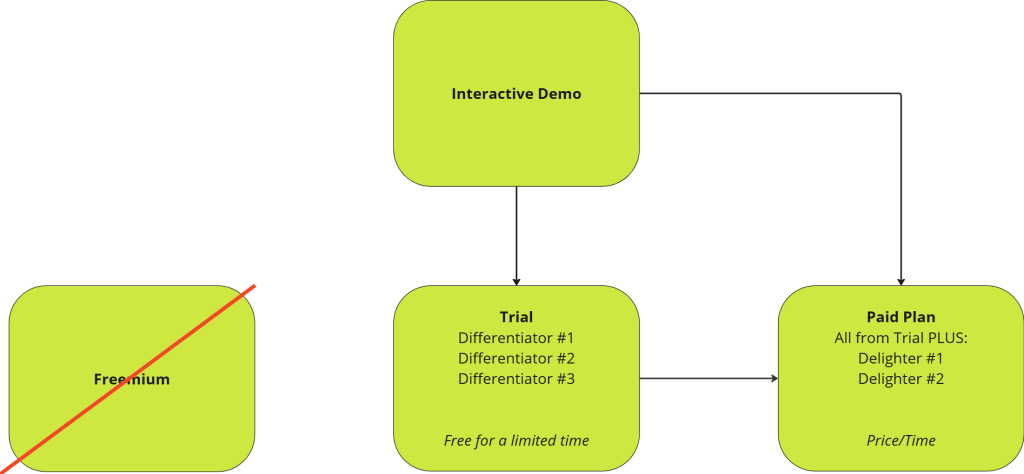
If you can’t include your crucial differentiators in a freemium, avoid having a freemium option and go straight to a trial instead. Never give a false impression of your pre-product, core product, and post-product value.
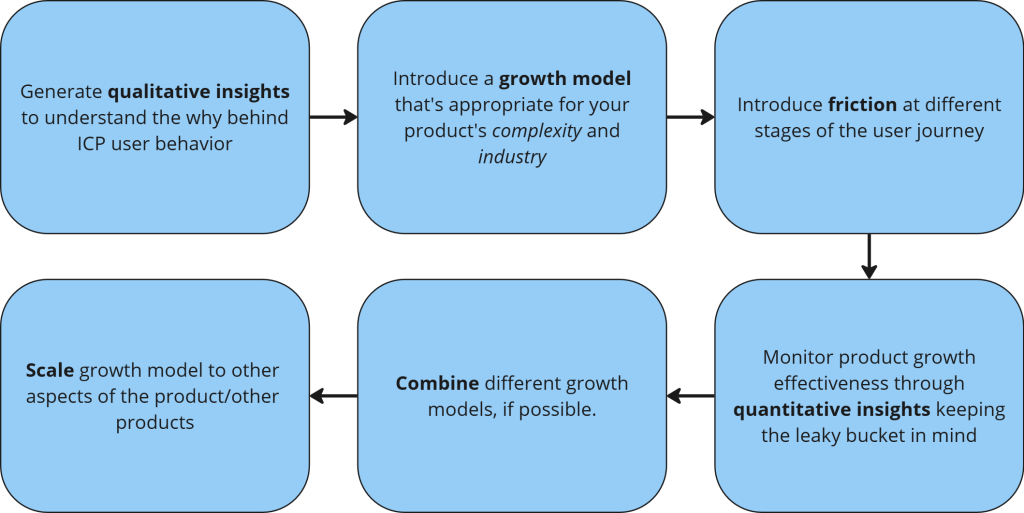
In summary, treat the different growth models (freemium, trial, reverse trial, and interactive demo) as tactics you can select individually, or combine with gated approaches to provide the user with a certain percentage of the total product value. Experiment with different levels of friction (and the timing of when they’re introduced) once you understand why certain ICP behaviors are exhibited at various stages of the customer journey through qualitative insights first before you validate them through quantitative metrics such as conversion rate. Don’t change too many things at once – this helps you see whether the metric that you’re isolating for is having any impact. Consider the complexity of your product and its limitations (as is typical in heavily regulated industries such as pharma, banking, and government) before selecting certain models to experiment with. Lastly, ensure that your bucket isn’t leaky and you’re retaining users before optimizing conversion and acquisition.

 Rahul Bhattacharya
1 thought on “Growth models & tactics”