

Imagine a battlefield in the 1800s where thousands of individuals are given a mission: “Conquer/defend this land”. That mission acts as the north star of what they want to achieve so that they can devise appropriate strategies for it, such as attack the enemy from the coast, ambush them from the highlands, or defend from behind the city walls.
Author Steven Bungay, in The Art of Action, describes how the Prussian army in the 19th century adopted mission-briefing, a form of communication that is based on leading by intent, to great success. The Prussian army realized that on the field, the army general couldn’t micromanage each unit and tell them what to do. Instead, soldiers had to know what to do in different situations to accomplish their mission. The practice of mission-briefing revolved around higher-ranking officers in the army articulating the intent for their mission to the next level of ranking officers, who then would do the same with their subordinates. The process repeated until every soldier in the army understood the overall intent. The intent would then have to be “back-briefed”, or communicated back up the chain of command to the general to ensure that it was properly understood. Such a practice allowed individuals throughout the chain of command to align on the intent so they could individually decide what actions were needed to achieve it. Without knowing the key objectives of a mission, it would have been impossible for task forces on the ground to create strategies and make decisions. The alignment to the intent, or mission, allowed individuals and units to autonomously make immediate decisions on the battlefield.
Similarly, the benefit of having a mission statement for a product or organization is to clarify what it intends to achieve. As L. David Marquet revealed in an earlier chat I had with him, providing intent means giving enough clarity over what you’re trying to achieve so that each of your team members can make decisions about the product, interactions with the client, operating the assembly line – whatever it happens to be. When leading a group of individuals in a complex environment, aligning on the mission allows the experts with “boots on the ground” to figure out the strategy and its respective tactics that would be needed to complete the mission. In rapidly-evolving markets, leading with intent in your organization can speed up decision-making without the need for each decision to go up the chain of command to a manager who would make the decision and then communicate it down to the team level. Furthermore, the managers in the latter case will often lack the information that the team-level individuals, who are the subject-matter experts, would have from working on the product every day.
While a vision describes an ideal future state that people want to build towards, a mission is what they are doing today to achieve it. A good mission statement describes how the vision, or a part of it, is going to be achieved. A mission may change partially or completely once every few years, based on changes in the market or customer needs and how the product would like to respond to those changes to achieve the product vision. Additionally, a mission statement should reflect the company’s values and can explicitly call out its intended customers.

Vision and mission statements are complementary to each other and provide context for the other. For example, let’s look at IKEA’s vision and mission.
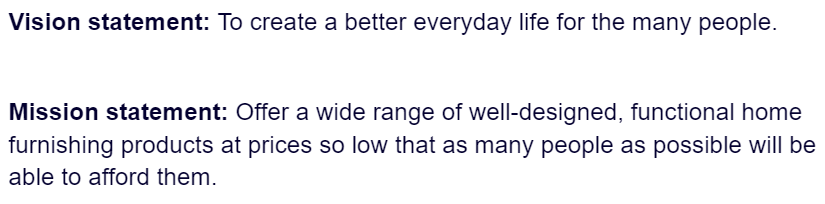
While IKEA’s ideal future state is to create a “better everyday life” for others, their mission statement describes how specifically they plan on improving the everyday lives of others. IKEA’s focus on “well-designed [and] functional home furnishing products” as well as a low price highlights their value proposition – comprehensiveness and affordability.
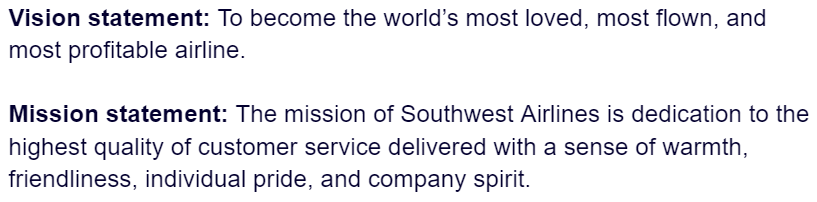
In another example, Southwest Airlines in the USA has a vision that is inward-looking rather than focused on solving a problem in society. Therefore, it is not very inspiring. However, their mission statement highlights their differentiator from their competitors and details how they plan to become the world’s most “loved, flown, and profitable airline”. Their value proposition of customer service is clear.
A common antipattern for organizations and departments when formulating mission statements is trying to fit every bit of their scope into the statement. I once supported a company developing a social media app to create a mission statement. Their management “didn’t want to leave out” parts of the organization that contribute to the app. We went from something along the lines of “Deliver the most secure social media platform across web and apps, based on game theory algorithms, brand marketing, and big data” to “Empower users to securely and seamlessly connect with their loved ones”. The organization’s values of security and seamless connectivity remained intact in the final version. It’s important that the mission statement is succinct without creating a list of departments that your product has. Focusing on what the customer value is, helps drive that conversation.
A large part of leadership is helping create an environment where individuals can understand, get behind, and translate the intent of an organization into strategies and day-to-day work. The most effective leaders find competent talent and give them problems to solve, rather than telling them what to do. Having a clear idea of what the organization wants to achieve through vision and mission statements can help departments, teams, and individuals figure out the best way to help the organization do so.
Having a vision and mission for a new product and organization are crucial. Once that foundation is set and clear, it then makes sense to understand the market, define a business strategy and model, and brainstorm different product strategies to carry out the vision and mission in practice. We will do a deep dive into understanding the market in the next blog post.

 Rahul Bhattacharya
5 thoughts on “Product mission”